
When Will Housing Prices Drop in Vermont Real Estate?

Across the country, housing prices are receding from pandemic-level highs. But when can we expect Vermont home prices to fall?
Vermont’s housing market has seen significant price increases over the last few years. Vermont median home prices increased by 15% in 2022, a record increase since Vermont started tracking the data in 1988. As noted by Vermont Real Estate Agent Sandy Palmer in a recent VT Digger article, the increase can be chalked up to a ‘perfect storm’ of circumstances, including the limited inventory of homes for sale, historically low-interest rates, local Vermonters looking to upsize or downsize, and an influx of new Vermonters including climate refugees and remote workers seeking a Vermont lifestyle. We’ve also seen an increase in absentee owners buying investment properties or second homes. While this has always been a dynamic of the Vermont real estate market, it isn’t isolated to our Green Mountain State. NBC recently analyzed 9 metro areas and found that absentee owner purchases are higher than pre-pandemic levels. This perfect storm created an environment where many buyers ask when prices will drop.
First, why are people expecting a drop in prices? Interest rates rose drastically in early 2023 as the Fed aimed to curb inflation. Rising interest rates often slow home demand as buyers feel the squeeze of reduced buying power. In other words, a couple who could afford a $500k single-family home last year with a 3% mortgage rate is out of the running this year for the same house due to the increased cost of monthly payments with a 6% mortgage rate. But, as Erin DuPuis, fellow Vermont Real Estate Company agent, points out in a recent Vermont Public interview that interest rates will certainly impact buyers more than sellers. While buyers were able to lock in rates as low as 2.5% a few years ago, the current rates aren’t that far off from ‘normal’ when you consider the historical context. Experts hope the peak is behind us, and some people are hopeful that the reduced demand powered by high-interest rates will soften price increases, even decrease prices in specific markets. So, yes, increasing interest rates will impact buyer demand, but only marginally. There may be a few fewer offers on homes, but interest rates alone won’t curb the historic demand we’re experiencing in Vermont.
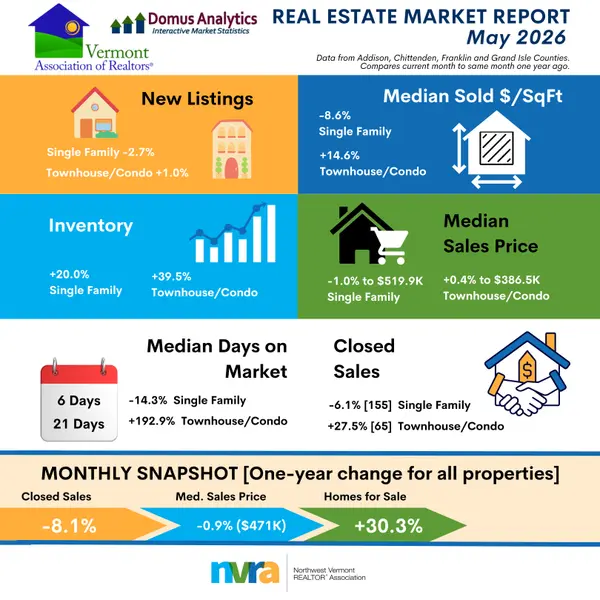
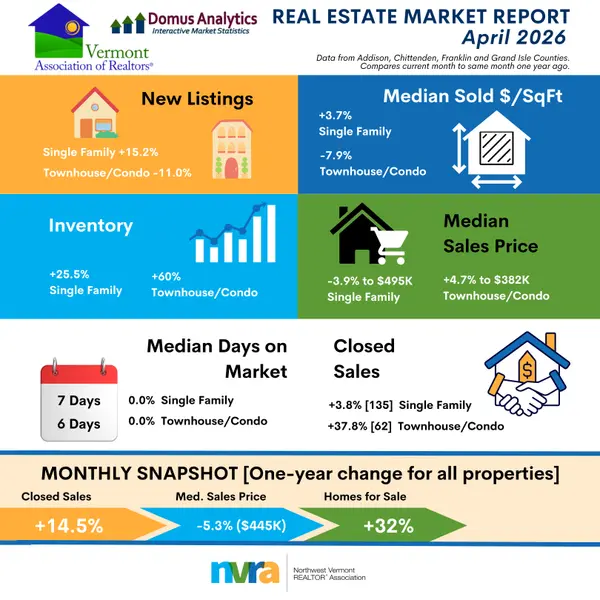
While Redfin reports that national prices have fallen YoY for the first time since 2008, the same can’t be said for Vermont. Across the State, the median sale price increased by 4% this year to date compared to the same period last year. But Vermont real estate is highly localized, with neighborhoods and towns across the State reacting to different market influences. Consider Addison (-6%) and Bennington (-8%) counties saw a drop in median sales price, while Chittenden (4%), Lamoille (15%), and Washington (20%) counties saw increases. As we try to read the crystal ball for the rest of 2023, it is hard to imagine extensive price drops throughout the State. The extreme market swings are likely behind us and prices won’t increase with the same velocity, but a decrease in home prices across the board shouldn’t be expected anytime soon.
Curious about changing prices and new trends in your town or county? Reach out for a quick analysis from one of our agents.
But, some experts argue that the global housing market is due for a correction of up to 19.5% and some regions and cities are already bearing witness to price decreases. When people see the potential of a drop this large, they often think back to the housing bubble of the early 2000s. But unlike then, homeowners today are locked into friendly interest rates with no urgency to sell, and the sellers’ market is insulated by historically low inventory. Even with rising inflation, current homeowners can make their monthly payments, sliming the odds for a large-scale sell-off and increased inventory. A recent Fortune article outlined the price corrections experienced throughout the nation. Most significant price decreases are happening in western states, with eastern price decreases focused in major metropolitan areas like D.C., Boston, and NYC. A quick glimpse at our State shows that we’re insulated from the same pressures impacting the rest of the country. Even our closest neighbors who show a correction, Glens Falls (-1.7%) and Pittsfield (-1%), barely register on the map.
So when can we expect prices to drop in Vermont? If they ever do, it will be once Vermont finds and implements a solution to the well-documented housing shortage. Our housing shortage isn’t a symptom of the pandemic. According to the 2020 Vermont Housing Needs Assessment report produced by Vermont Housing Finance Agency, the number of homes in Vermont increased by around 1% each year and is likely to be stagnant by 2025. The report also notes that the decline and stagnation of new homes are happening in every county in the state, not just Chittenden County.
Further, a recent report from the Northwest Regional Planning Commission found “Franklin and Grand Isle counties need 3,350 new or improved housing units to meet the needs of current residents”, let alone the needs of an influx of future residents. The Vermont housing shortage is a divisive and complex topic. The State Legislature is considering significant changes in how new construction is approved and permitted with three new bills, and we’ll see if they are passed into law. But, the cause of the shortage runs deeper than zoning and Act 250. Gary Winslett, Assistant Professor of Political Science at Middlebury College, writes at length about the multiple issues influencing the housing shortage.
So, while prices aren’t likely to come down anytime soon. What can buyers and sellers do? Sellers should start by getting a competitive analysis of their home value. While price increases are slowing, we’re very much in a sellers’ market with many advantages leaning to homeowners. The biggest hurdle for sellers is figuring out where to go. While they are primed to earn a significant return on their home investment, sellers will still need to sit in the buyer’s seat to find a new home. Buyers need to start their search now and plan for a long-term approach to finding the home that meets their needs. They also need to consider compromising on some of their must-haves and save for a larger down payment to combat rising interest rates.
Buyers or sellers looking to navigate the Vermont real estate market should schedule a call with one of our friendly and knowledgeable agents. We’re here to help you accomplish your real estate goals.
Categories
Recent Posts




GET MORE INFORMATION